
Don’t Get Scammed – Your Complete Guide to Rental Fraud & Screening Protection
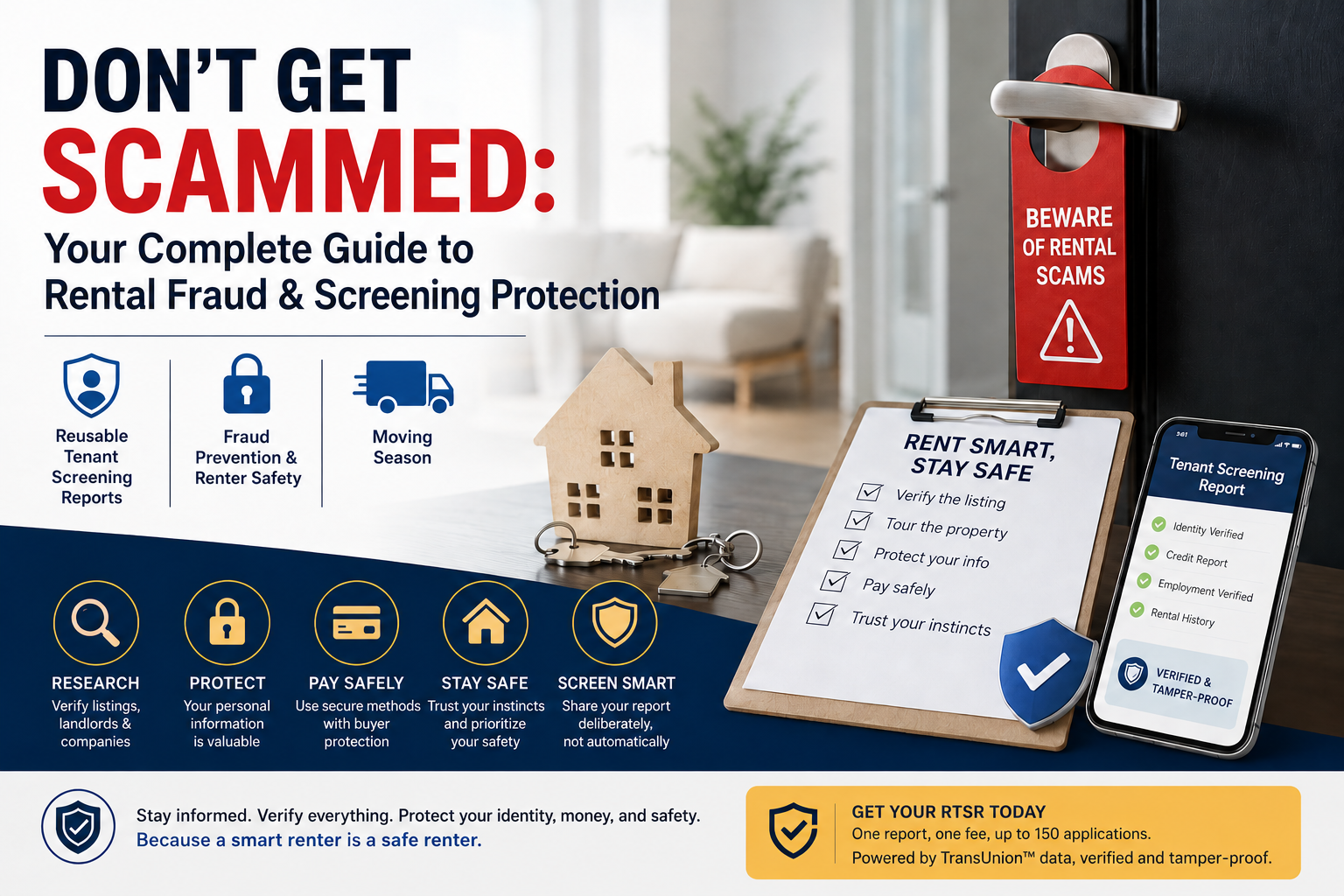
Moving season brings opportunity — and criminals who exploit it. Here’s how to protect your identity, money, and safety at every step of your rental search.
You’ve found what appears to be the perfect rental. The price is right, the photos are gorgeous, and the landlord seems responsive. But before you wire a deposit or share your Social Security number, ask yourself: how do I know this is real?
Rental fraud is one of the fastest-growing forms of consumer fraud in the US — and it doesn’t just cost money. It costs time, emotional well-being, and, in some cases, safety. Whether you’re a first-time renter or a seasoned mover, this guide will walk you through every major scam circulating today, and exactly what you can do to protect yourself.
8 Rental Scams You Need to Know Right Now
Shannon McBride, ReusableTenantScreeningReports.com
“Fraudsters rely on urgency, emotion, and information asymmetry — here are the 8 scams every renter needs to watch out for.”
Fraudsters rely on urgency, emotion, and information asymmetry. Understanding their tactics removes that advantage.
The phantom listing:A real property — often copied from Zillow or Realtor.com — is reposted with a fake landlord’s contact info. The “landlord” claims to be traveling or overseas. You’ll never see the unit.
The deposit-before-viewing trap: You’re asked to pay a holding deposit before ever seeing the property. Legitimate landlords don’t require payment before an in-person showing. Walk away — or at minimum, insist on a visit first.
The identity harvest: A fake application form collects your SSN, date of birth, and banking info under the guise of “screening.” The data is sold or used to open fraudulent accounts.
The non-refundable fee scam: Application fees are charged to dozens of applicants for a unit that was never available — or for which the “landlord” has no authority. No refund is ever issued.
The auto-blast PTSR abuse
Some services automatically broadcast your tenant screening report — including sensitive personal data — to every available property in an area without your deliberate consent. Your private information shouldn’t be mass-distributed.
The urgency pressure scam: “This unit will be gone by tonight — pay now to hold it.” Urgency is the scammer’s most powerful tool. Legitimate landlords give qualified applicants a reasonable time to make a decision.
The staged or stolen listing: AI-generated or stolen listing photos that don’t match the actual unit. Reverse-image-search any listing photos that seem too polished or inconsistent with the asking price.
The unauthorized subletter: A current tenant illegally sublets to you — collecting your deposit and first month’s rent — without the property owner’s knowledge. When the actual landlord finds out, you have no legal standing.
Protect Your Personal Information Like a Pro
By the numbers: According to the FTC’s December 2025 Consumer Protection Data Spotlight, consumers reported nearly 65,000 rental scams between 2020 and June 2025, resulting in $65 million in losses — with a median loss of $1,000 per incident. About half of all reported scams originated with a fake listing on Facebook. Renters ages 18–29 were three times more likely to lose money to a rental scam than other adults.
Source: FTC Data Spotlight, December 2025
Your Portable Tenant Screening Report (PTSR) contains some of the most sensitive data you own: credit history, employment records, rental history.” Treat it like your passport.
- Share deliberately, not automatically. Some platforms auto-submit your PTSR to every listing the moment a unit becomes available. This means your sensitive data is sent to dozens of unknown recipients without your individual review of each property or landlord. Choose platforms that let you control exactly who receives your report.
- Vet the recipient before sharing. Confirm you’re dealing with either the verified property owner or an authorized representative. Ask for documentation of their authority. A legitimate landlord won’t hesitate to provide it.
- Use a reusable report from a reputable source. Check Google Reviews before choosing any screening service. Platforms like Reusable Tenant Screening Reports (RTSR), powered by TransUnion™ data, verify report integrity — ensuring your report hasn’t been altered and is current — so landlords can trust it and you can control its distribution.
- Never submit personal documents unsolicited. A landlord who asks for a copy of your passport, pay stubs, or bank statements before you’ve toured a property and received a formal application is a red flag, not a routine request.
How and When to Pay – Without Losing Your Money
Payment methods are one of the most exploited vulnerabilities in rental fraud. Here’s a straightforward comparison of your options:
| Payment method | Dispute protection | Recommendation |
| Credit card | Strong – chargeback rights under federal law | Preferred |
| Personal check | Moderate – stop-payment option available | Acceptable |
| Zelle / Venmo (no purchase protection enabled) | None – treated as cash, rarely recovered | High risk |
| Wire transfer | None – essentially irreversible once sent | Avoid entirely |
| Cash | None – no paper trail, no recourse | Never for deposits |
| Gift cards or cryptocurrency | None – a universal scammer red flag | Always a scam |
One more rule worth remembering: holding deposits should always be credited toward your first month’s rent or security deposit. If you’re not approved, you’re entitled to a refund. Get this in writing before paying anything.
Stay Safe When Touring Properties
Personal safety during property tours is a topic that doesn’t get enough attention, especially if you’re a woman or renting solo.
- Bring someone with you. Tour properties with a friend, family member, or trusted colleague whenever possible. This deters bad actors and gives you a second set of eyes.
- Verify the showing agent’s authority. Ask how the person showing you the property is affiliated with it. Can they demonstrate access to every room? Can they provide ownership documentation or a property management agreement? If someone has genuine control, they can prove it.
- Trust your instincts completely. If something feels wrong – the person seems nervous, the property doesn’t match the listing, or the story keeps changing – leave. No apartment is worth compromising your safety. You can always find another unit.
- Apply the too-good-to-be-true test. A luxury unit in a prime neighborhood listed 30% below market? A landlord who just wants a “good person” and skips screening? These aren’t strokes of luck – they’re warning signs. Market pricing exists for a reason.
- Meet in public first if anything feels uncertain. If you haven’t verified who you’re meeting, suggest a quick video call or a brief in-person introduction in a public place before entering a private property.
Specific Warning Signs in the Screening Process
- A landlord asks you to pay for screening through an unfamiliar or unverified platform, or directs you to a site that doesn’t match their stated company name.
- The screening service has no verifiable Google presence, no reviews, or reviews that all appeared within a short period (a sign of fake-review manipulation).
- You’re asked to provide your screening report via email rather than through a secure, verified platform — reports shared this way can be altered and your data isn’t protected in transit.
- The “landlord” requests multiple separate application fees for the same unit, or can’t clearly explain what the fee covers.
- Communication happens only through informal channels (WhatsApp, social media DMs) with no verifiable business email or address.
- The landlord is never available for a video call or in-person meeting, citing travel or remote work — a classic phantom-listing tell.
5 Ways to Cut Moving Costs Without Cutting Corners
Staying safe doesn’t have to mean spending more. Here’s how savvy renters keep costs down without taking risks:
- Get a Portable Tenant Screening Report. One PTSR can be shared with multiple landlords – up to 150 applications on some platforms – at a fraction of the cost of repeated application fees. Just make sure to choose a reputable provider with verified reviews and state-law compliance.
- Source boxes through Facebook Marketplace. Moving boxes – and durable plastic tubs – are often available for a fraction of retail, sometimes free. Search the week before your move locally.
- Right-size before you pack. Sell or donate items you no longer need before moving. Less volume means lower moving costs – and potentially some extra cash from sales.
- Furnish smart, not retail. Consignment shops, Facebook Marketplace, estate sales, and outlet stores like Wayfair can yield significant savings on furniture. Buy after you move-not before-so you don’t have to transport items twice.
- Move midweek, mid-month. Movers are in highest demand on weekends and at the start/end of the month. Booking midweek and mid-month often secures better rates meaningfully. And always start early – movers are freshest (and fastest) in the morning hours.
The rental market is competitive — but that pressure should never push you into a hasty decision. A legitimate landlord wants a qualified tenant, not a rushed one. Take your time, verify everything, and protect your information like the valuable asset it is.
Ready to rent smarter and safer?
Get a Reusable Tenant Screening Report — one report, one fee, up to 150 applications. Powered by TransUnion™ data, verified and tamper-proof.